AAOIFI-certified core to simplify Shari'ah-compliant banking
iMAL is the world’s leading Islamic banking platform and the only AAOIFI-certified core built specifically for Shari’ah-compliant finance. Covering retail, corporate, treasury, investment, trade finance, and microfinance, iMAL offers a comprehensive suite of solutions that enable institutions to deliver ethical, inclusive, and scalable banking, combining uncompromising compliance with agility and innovation.
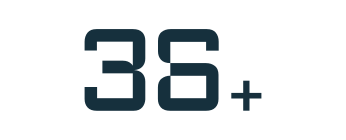
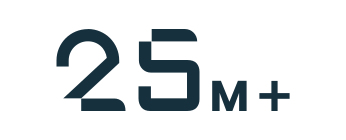
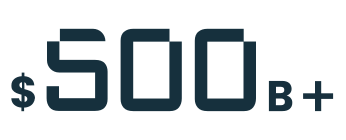
Impact by numbers.
countries live across the Middle East, Africa, and Asia
branches operating on the platform
customer accounts managed
assets supported
Leading Islamic banking forward
Compliance by design
Every product and process in iMAL is Shari’ah-aligned by default. This reduces compliance risk, strengthens governance, and provides regulators, boards, and customers with full confidence in every transaction.
Agility to scale
A modular, parameter-driven, flexible platform that empowers banks to launch new offerings quickly, expand into new markets, and scale operations efficiently without disruption.
Digital-first & future-ready
API-first and cloud-ready, iMAL integrates seamlessly with mobile, online, and open banking ecosystems, enabling modern, customer-centric journeys and preparing institutions for future digital innovation.
Comprehensive coverage for all Islamic banking needs
Islamic core banking
A robust, Shari’ah-compliant foundation that supports multi-entity, multi-currency operations with real-time processing, regulatory reporting, and a 360° customer view.
End-to-end lifecycle management for Islamic financing products—covering origination, disbursement, repayments, and collections—ensuring compliance and efficiency at every step.
An AAOIFI-certified profit calculation engine that automates accruals, allocations, reserves, and distributions. With advanced pool management, it enables banks to set up, monitor, and manage profit-sharing pools with full transparency.
Comprehensive Islamic treasury management with real-time coverage of money markets, FX, and risk controls to optimize liquidity and strengthen financial resilience.
Full-spectrum Islamic portfolio and fund management supporting sukuk, equities, commodities, and NAV—designed to streamline compliance and improve returns.
Shari’ah-compliant trade finance that simplifies guarantees, letters of credit, and collections with automated workflows and built-in compliance checks.
Inclusive, ethical financing for underserved communities with flexible models for group and individual lending, agent-driven workflows, and mobile support.
An API-first, cloud-ready architecture that connects seamlessly with mobile, online, and open banking ecosystems to deliver secure and seamless omnichannel customer experiences.
We are excited to partner with Azentio as our chosen core-banking technology partner to support our ongoing business growth. The iMAL platform, with its inclusive features and commitment to Islamic banking principles, aligns with our objectives. This collaboration will support our teams in streamlining processes, enhancing productivity, and improving the omnichannel customer journey.
Amjad Hijazi
Chief Operating Officer, Siraj Finance
With Azentio, we’ve achieved full Shari’ah compliance while streamlining our operations and delivering transparent, efficient services to our customers. The solution has been a reliable backbone in our journey to scale and lead in Ethiopia’s interest-free banking sector.
Daniel Hailu
CIO, Bank of Abyssinia
At BankIslami, we are committed to providing best-in-class services while driving aggressive nationwide expansion. To fuel our growth, we need solutions aligned with global trends and capable of supporting our vision. The iMAL R14 upgrade is a critical step forward, equipping us with the technology to enhance efficiency and continue delivering innovative, Shari’ah-compliant financial solutions.
Rizwan Ata
President & CEO, BankIslami
Azentio has been a core enabler in our journey to becoming a digital first, Shari’ah-compliant corporate bank. Their AAOIFI certification and seamless integration offerings have helped us launch on time and build a solid foundation for future expansion.
Parvin Jain
CEO, Vision Bank
Insights
Explore our insights.
Find out more about the latest Azentio news, innovations, and market trends shaping our industry.
Placeholder for insights posts
Frequently asked questions
Is Islamic banking only for Muslims?
No. Islamic banking is open to everyone, Muslim and non-Muslim alike. Its principles of ethical finance, transparency, and fairness appeal to a wide audience seeking values-based financial services.
What is the difference between Islamic and conventional banking?
Islamic banking prohibits interest (riba) and avoids speculative transactions (gharar). Instead, it emphasizes asset-backed financing and risk-sharing partnerships. Conventional banking, by contrast, is interest-based and often involves greater exposure to debt and derivatives.
What is riba, and why is it prohibited?
Riba is the practice of charging interest, and it’s strictly prohibited in Islamic law. It’s considered exploitative and contrary to the ethical and moral principles of Islam. Islamic finance encourages equitable wealth distribution and mutual benefit, which riba undermines.
What is Takaful, and how is it different from traditional insurance?
Takaful is a cooperative Islamic insurance model where participants contribute to a shared pool to cover each other’s losses. Unlike conventional insurance, Takaful is based on mutual responsibility and avoids interest, gambling (maysir), and uncertainty (gharar), all of which are prohibited in Islam.
What is AAOIFI and why is certification important in Islamic banking?
AAOIFI stands for the Accounting and Auditing Organization for Islamic Financial Institutions. It is the global standard-setting body for Islamic finance, headquartered in Bahrain. AAOIFI issues authoritative standards on:
Shariah compliance
Accounting practices
Governance
Ethical conduct
Why AAOIFI certification matters:
Ensures authenticity and alignment with Shariah law.
Provides trust and credibility with regulators, scholars, and customers.
Signals to Islamic financial institutions that a product or system (like Azentio’s iMAL) has been rigorously reviewed and approved.
Azentio’s iMAL solution is AAOIFI-certified, demonstrating our deep commitment to Shariah compliance and international best practices.
Are Islamic banking products more expensive than conventional ones?
Not necessarily. While the structure of Islamic financial products may differ (e.g., profit-based instead of interest-based), they are often competitively priced. In fact, many customers value the ethical framework and transparency that Islamic finance offers.
How does Islamic banking support economic growth?
Islamic banking supports real economic development by financing tangible assets and productive ventures. It also:
Encourages long-term partnerships
Supports small and medium enterprises (SMEs)
Fosters financial inclusion across underserved populations
Connect with Azentio
Let's begin our journey together.
We’d love to hear from you and answer your questions.